Interlude: Embrace the Nostalgia
One of the reasons I still play Quake after all these years is nostalgia.
When I fire up Quake, load an old map, and hear those familiar sounds, I feel like a sixteen-year-old kid again.
For a little while, I’m back in the 1990s, discovering new maps, experimenting with modifications, and getting excited about the latest developments in the Quake community.
It’s time travel, and it’s free.
Something similar happens when I’m researching old Quake modifications.
I’ll discover an archived news website, an old forum discussion, or a collection of Usenet posts, and suddenly I’m transported back thirty years.
Sometimes I’ll even come across a news article that I remember reading when it was first published.
It’s a strange and wonderful feeling.
Getting Lost in the Past
Over the years, I’ve found myself spending entire weekend afternoons stepping through old news posts on sites like Blue’s News and Redwood’s News.
I’ll start by looking for a particular modification announcement or release date.
Then I’ll notice another headline that catches my attention.
Perhaps it’s an announcement for a new bot, a preview of an upcoming modification, or news about an official Quake patch.
I’ll click through and read it.
Then another.
Before long, I’ve forgotten what I was originally searching for and I’m simply reading the news from 1997 or 1998, one day at a time.
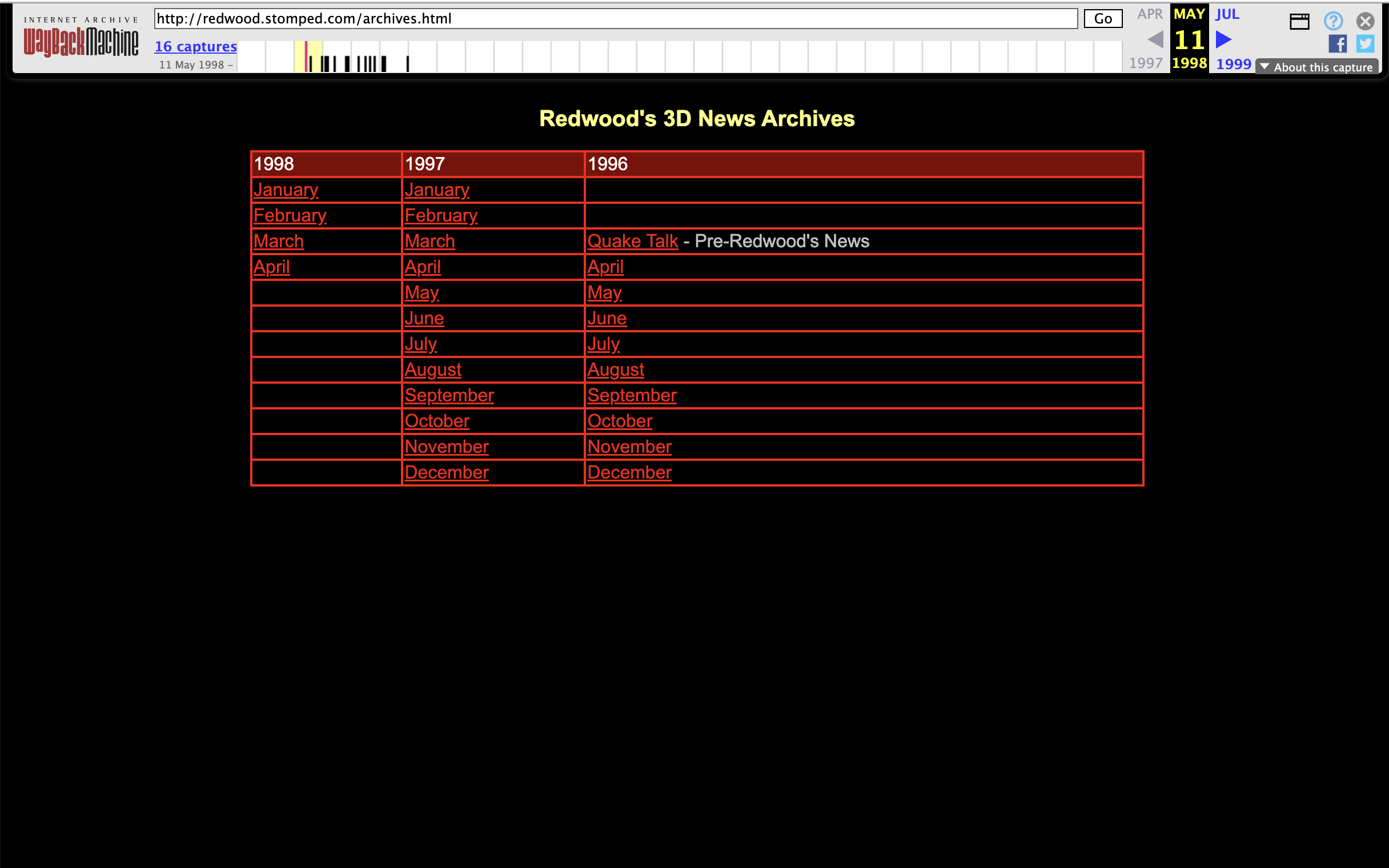
Figure: Snapshot of Redwood’s 3D News archives on the Wayback Machine.
I’m rediscovering all the excitement surrounding new releases, following the development of modifications I remember, and being reminded of projects I’d completely forgotten about.
There’s something wonderful about experiencing that history as it unfolded, rather than reading a modern summary of what happened.
The same thing happens with Usenet.
I’ll find an old discussion about a Quake modification or some technical problem a developer was trying to solve.
Instead of extracting the one piece of information I need, I’ll read the entire thread.
Then I’ll follow another discussion.
And another.
Sometimes I recognise the names of people who were active in the community. Sometimes I remember the arguments, the excitement, or the ideas being discussed.
It’s unlike almost anything else.
Give Yourself Permission to Wander
I think it’s important to allow yourself these moments.
Throughout this book, I’ve encouraged you to be systematic in your research, maintain good records, follow leads, and stay focused on recovering missing files.
That’s all useful advice.
But sometimes, I think you should forget about the research project for an afternoon.
Stop worrying about your wishlist, missing releases, and historical download URLs.
Open an old Quake news archive and start reading.
Follow your curiosity.
Revisit the announcements, the rumours, the development updates, and the community discussions.
Remember what it felt like to be excited about a new Quake modification.
Allow yourself to be a teenager again, or whatever age you were when you first discovered the game.
You might stumble across something useful for your archive. In fact, I often do.
But that doesn’t have to be the point.
Sometimes, the reward isn’t finding a missing file. It’s simply getting to relive a little piece of the past.
And I think that’s one of the best parts of being a Quake archivist.