Interlude: Why I Created QuakeDiscs
For years, one of my favourite places to look for missing Quake files has been old CD-ROM collections.
The Internet Archive hosts thousands of magazine cover discs and third-party game compilation CDs, many containing Quake modifications that are difficult or impossible to find elsewhere. It’s a great resource!
When I started researching Quake modifications, I would regularly download these discs and manually inspect their contents, looking for missing releases.
It was slow work.
I’d download a CD image, mount or extract it, browse the directories, and search through the files. Sometimes I’d find exactly what I was looking for. Other times I’d spend hours examining a disc and come away empty-handed.
Eventually, I started indexing the contents of some of these discs so I could search them again later without having to repeat the process.
Then someone in the Quake community introduced me to something remarkable.
Discovering DiscMaster
They pointed me towards DiscMaster (http://discmaster.textfiles.com), a search engine that indexes enormous collections of historical files, particularly CD-ROMs and FTP archives preserved on the Internet Archive.
I thought it was amazing.
In fact, I still do.
Almost immediately, I found missing Quake files that I’d been searching for, sometimes for quite a long time.
Instead of downloading a collection of CDs and manually inspecting their contents, I could simply search for a filename and discover which discs contained it.
It was enormously convenient, and I still use DiscMaster heavily in my archival research.
But there was one thing that frustrated me.
DiscMaster had indexed many Quake CDs, but not all of them.
I knew this because I’d encountered several community efforts over the years to catalogue third-party Quake add-on discs.
These lists mentioned many CDs that weren’t included in DiscMaster’s index.
Some were already available on the Internet Archive. Others could be found in different online collections, and some were proving difficult to locate at all.
I kept thinking about how useful it would be to have a searchable index dedicated specifically to Quake CDs.
Eventually, I decided to create one.
Building QuakeDiscs
I started by trying to identify every third-party Quake CD I could find.
I searched old websites, disc catalogues, archived advertisements, community discussions, and anything else that might mention a Quake compilation.
I collected CD titles, publishers, publication dates, cover images, and whatever historical information I could uncover.
Then I started hunting for the discs themselves.
I searched the Internet Archive, but I didn’t limit myself to that collection. I looked through other archives, mirrors, and personal collections, trying to obtain copies of as many discs as possible.
Once I had a disc, I indexed its contents.
Importantly, I didn’t stop at listing the files in the disc’s directories.
Many Quake modifications were distributed inside ZIP, RAR, ARJ, PAK, and other archive formats. Sometimes those archives contained further archives.
I wanted to make those files searchable too.
The result was QuakeDiscs (https://QuakeDiscs.com), a dedicated catalogue and search engine for third-party Quake CDs.
I created a website with cover images of the discs, information about their publication, and detailed file listings.
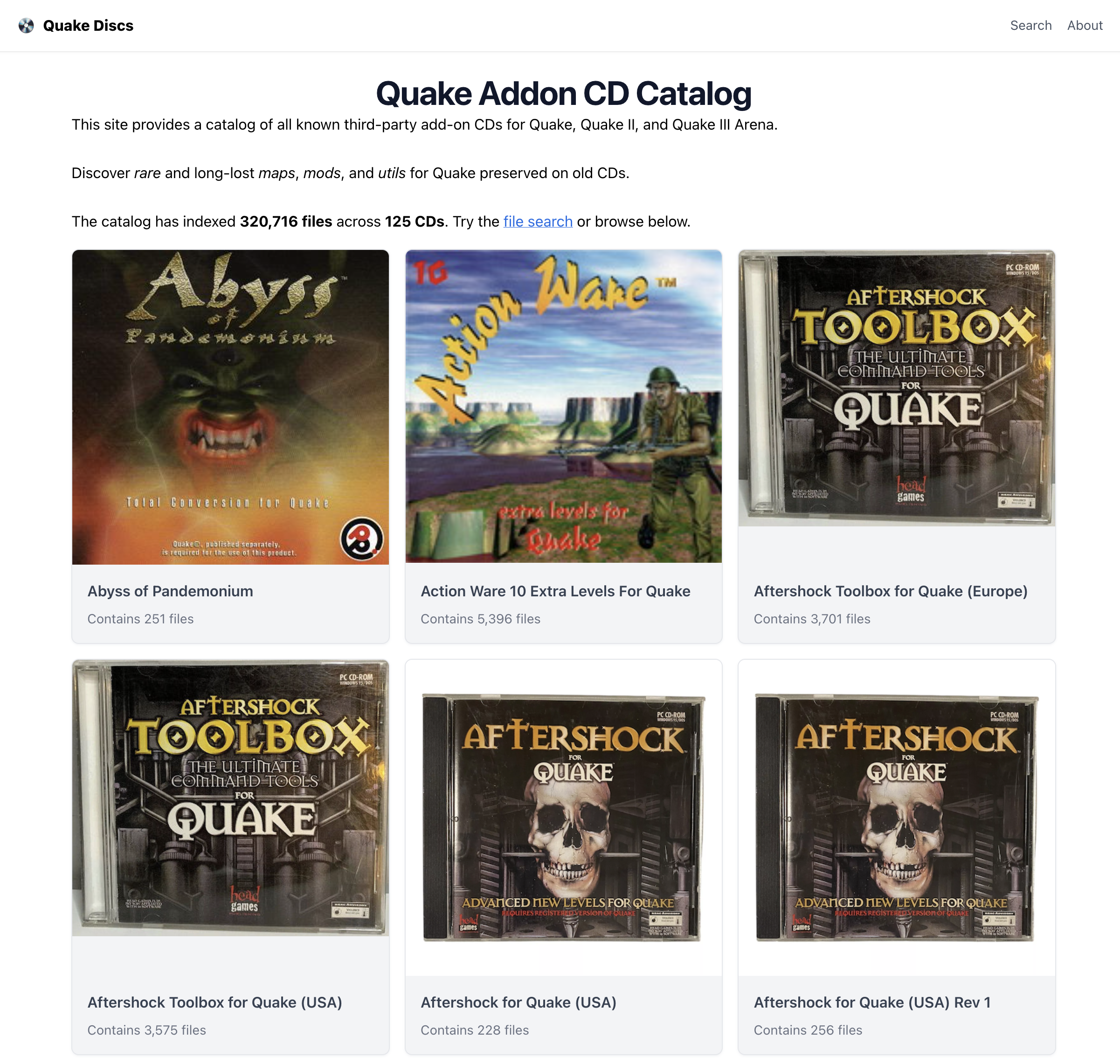
Figure: The QuakeDiscs catalogue of historical third-party Quake CD-ROMs.
Most importantly, I added a search interface that lets you look for files across the entire collection without knowing which CD might contain them.
Initially, I focused on third-party Quake 1 add-on CDs and magazine cover discs containing substantial amounts of Quake 1 material.
Later, I expanded the collection to include Quake II and Quake III Arena discs.
At the time of writing, QuakeDiscs catalogues 125 third-party Quake CDs, with more than 320,000 files in its search index.
Why It Matters
One of the difficulties with searching old CD collections is that files weren’t always distributed under their original names.
A modification originally released as something.zip might have been renamed, extracted into a directory, or repackaged as part of a larger compilation. Especially if it was distributed on BBS.
Sometimes the original archive is missing entirely, but its contents survive as individual files on a CD.
This makes searching for missing releases surprisingly difficult.
You might search for an exact filename and find nothing, even though the modification is sitting on a disc under a different name or in an extracted directory.
Having an index of the files inside archives makes it possible to search for alternative filenames, distinctive README files, or other clues that might identify a missing release.
QuakeDiscs doesn’t host the CD images themselves. Instead, it helps you discover which discs contain particular files, so you can track down the original media and investigate further.
It’s the sort of resource I wished existed when I started creating Quake archives.
So I built it.
You can explore it here:
- QuakeDiscs
https://QuakeDiscs.com/
I hope you find it useful.
And if you’re wondering whether building an entire website and search engine just to avoid repeatedly downloading and inspecting old Quake CDs might be a little excessive, you may have a point.
But it’s saved me an enormous amount of time, and I hope it saves you some too.